
Biography
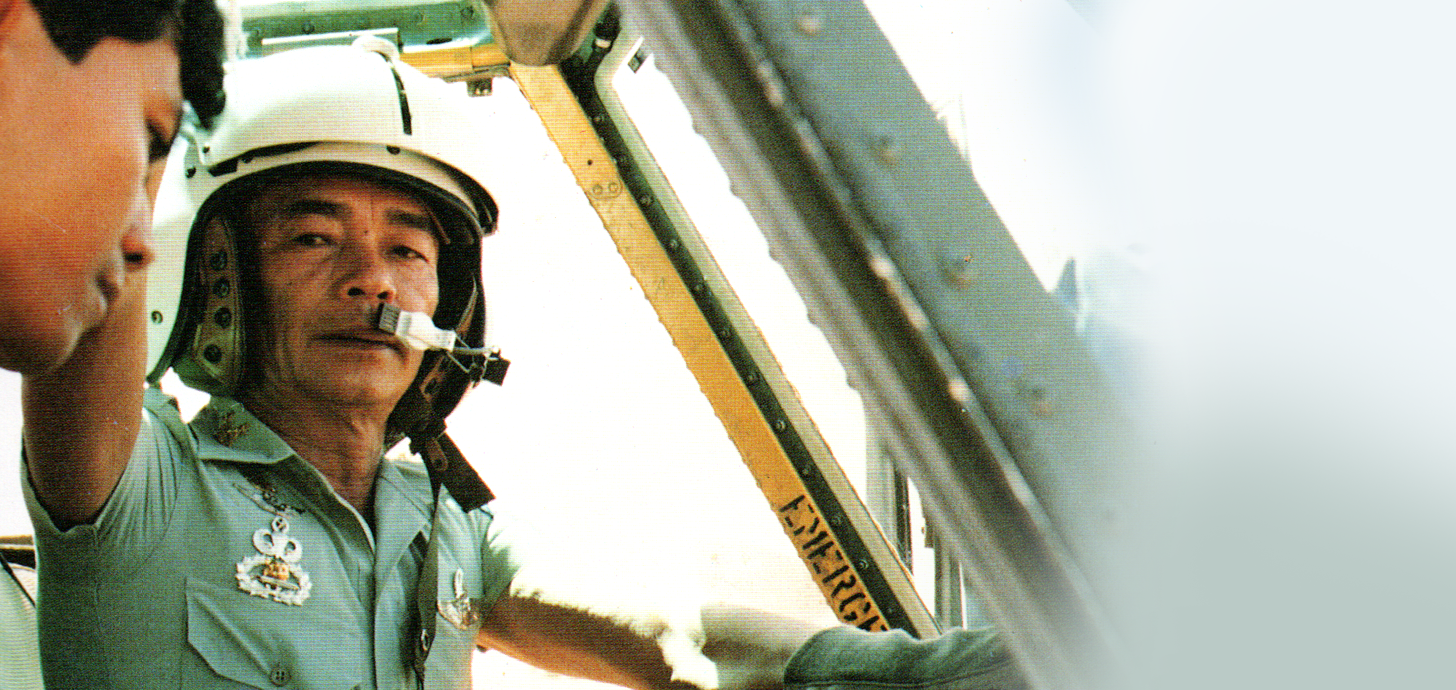
General Sundhara Kongsompong
Founding Chairman of the Foundation


Signs of Leadership / Academic Excellence / Diligent Studies / Friendly Relations /
Journey to the Capital / Top Scorer / Living Simply / Honor and Dignity


was born on Saturday, August 1, 1931, at 171 Prachathipatai Road, Village No. 2, Bang Khen Subdistrict, Bang Khen District, Phra Nakhon Province. He was the first child of Air Commodore Supachai and Mrs. Lamoon Kongsompong and had three younger siblings—two brothers and one sister.
He later moved to Bangkok and continued his primary education in the second grade at the Don Mueang Municipal School (Air Force Utit School). As a child, Sundhara was intelligent and preferred playing to attending school. His father had to compel him to attend. Each time he went to school, he would often ride on a soldier’s shoulders. His academic performance was consistently good, always ranked in the top positions.
While in the second grade, he scored so well that he was specially promoted to the third grade mid-year. After completing the fourth grade, he pursued his secondary education at Don Mueang Secondary School (Air Force-sponsored) through the third year of secondary school.
In 1941, World War II began, and his father was transferred to Saraburi Province. Sundhara followed and continued his studies from secondary grades 4–6 at the provincial boys’ school. The school’s initials S.B.1 were embroidered on his shirt, with student number 3050. Today, the school is known as Saraburiwitthayakhom School. Among his notable schoolmates was Air Chief Marshal Kaset Rojanil, who later became Commander-in-Chief of the Royal Thai Air Force and Vice Chairman of the National Peacekeeping Council.
While in Saraburi, his mother closely supervised him, which fostered his love for reading. During school breaks, he would always buy textbooks for the next year and complete all the exercises in advance. He continued this practice every year, even after entering the Command and General Staff College.
In his spare time, he would peel bamboo piles for 10 satang each and used the earnings to treat his friends.
After completing secondary education, he moved to Bangkok to study at the preparatory level, attending Suankularb Wittayalai School for grades 7–8 in the literature program.
At the same time, he also attended science preparatory classes at Charnwit Pittayalai School (Saphan Luang) and sat for the equivalency exam in the eighth-grade science stream, ranking among the top 50 nationwide in 1948.
While studying at Suankularb Wittayalai School, Mr. Sundhara lived with monks at Wat Mahathat, accompanying them on their alms rounds each morning. He relied on leftover alms food for his daily meals. On days when monks could not collect alms, he would boil the dried leftover rice to offer to the monks before eating himself.


While at Suankularb Wittayalai, he never burdened his friends and endured hardships, such as hunger and reading by candlelight due to the lack of electricity at the monk’s quarters. Despite many challenges, he never gave up and continued to excel academically.
His fellow classmates who also became military officers included General Phat Akkhanibut, Lieutenant General Anuwat Thapklai, and Lieutenant General Chaiyanat Thareechat. Notable civilian classmates included Mr. Suthee Akasrik and Mr. Thongbai Thongpaot.
While in secondary school, Sundhara was also actively involved in sports, especially Takraw (kick volleyball).
Beginning as Second Lieutenant / Korean War Combat


On September 29, 1954, he was reassigned to the Infantry Center Headquarters at Narai Maharaj Camp, Lopburi Province, to attend the Company Commanders’ Course, Class 14, at the Infantry School, Infantry Center (Basic Course, Class 3).
By January 9, 1955, he was officially commissioned as a Second Lieutenant without the prefix “Acting,” and continued serving at the Infantry Center Headquarters until June 20, 1955.

On June 21, 1955, he was transferred to the 1st Infantry Battalion (Independent), under the 21st Composite Regiment. Later, on September 15, 1955, this unit became part of the Replacement Unit, 1st Infantry Battalion, 21st Composite Regiment. He held the position of Small Arms Platoon Commander in the Rifle Company and volunteered to join the United Nations combat mission in the Korean War.
Due to his bravery and distinguished service in this mission, Second Lieutenant Sundhara Kongsompong received the “Victory Medal” (Korean War Campaign) on October 11, 1955, as a mark of honor. He was also awarded the Fifth Class Order of the Crown of Thailand on December 5 of the same year. He served in the Korean War until June 26, 1956, when he returned to Thailand.
Vietnam War / Distinguished Merits / Service to the Nation

On January 17, 1969, he was appointed Chief of Operations for the Volunteer Military Division serving in the Vietnam War. He was assisted by Lieutenant Colonel Thamniap Thammanee, Major Issarapong Noonphakdee, Major Siri Tiwaphan, Major Chamlaeng Ujukhomol, and Major Khajon Ramanyawong.

He served in Vietnam until August 14, 1970, when he returned to his homeland.
Distinguished Merits
1. U.S. Army Commendation Medal with “V” Device: Awarded on March 21, 1970, for acts of valor during combat operations against enemy forces. His bravery and sacrifices were recognized and admired by allied nations.
2. U.S. Army Commendation Medal with “First Oak Leaf Cluster”: Awarded on June 11, 1970, for his outstanding duty performance, which was commended in the citation.

3. U.S. Bronze Star Medal with “V” Device: Awarded on November 10, 1970, for heroic acts during combat operations.
4. Republic of Vietnam Gallantry Cross with Palm: Awarded on July 10, 1970.
These honors symbolize the valor of Thai soldiers in the Vietnam battlefield, recognized internationally for their tactical skills and heroism. One of these honored warriors was Lieutenant Colonel Sundhara Kongsompong, who served as the Chief of Operations.


Graduation from Army Aviation School
Inspired by his combat experience in Vietnam, where he frequently operated rotary-wing aircraft during operations against the Viet Cong and was involved in emergency control of aircraft, along with his admiration for the harrowing experience at Ban Huai Suea Kat Chang in 1972, where he narrowly escaped death, and the legacy of his father, Air Commodore Supachai Kongsompong, who was an Air Force pilot, Colonel Sundhara Kongsompong decided to transfer to the Army Aviation Department on April 1, 1973.
He enrolled in the 13th Army Aviation Cadet Course and completed both primary and secondary levels, thus fulfilling his ambition to become an Army pilot.


On March 25, 1974, he was appointed Deputy Commander of the Army Aviation Department with the rank of Colonel, holding this position until December 19 of the same year.
On December 20, 1974, he was promoted to “Colonel (Special)” and appointed Chief of Staff at the Special Warfare Center. He held this post until October 31, 1977. During this period, he traveled to the United States for special meetings and study visits, including :
- • Observing aircraft and helicopter development at Hughes Aircraft Company in California
- • Attending a special forces conference at Fort Bragg, North Carolina
- • Observing special combat training and parachuting at Fort Benning, Georgia
- • Studying aviation training and activities at Fort Rucker, Alabama
- • Visiting and meeting with personnel at the U.S. Department of Defense’s Special Operations and Intelligence Divisions at the Pentagon in Washington, D.C.
During this time, he was granted the Companion (Second Class) of the Order of the Crown of Thailand on December 5, 1975.
Royal Weapons Training / Operation Pha Muang / Leading the Aircraft / Acts of Heroism

From November 1977 to September 30, 1981, he served as Deputy Commander of the Army Aviation Center. During this period, he was conferred the Companion (Second Class) of the Most Noble Order of the White Elephant on December 5, 1978.
Between September 22 and December 9, 1980, he was assigned to provide training in the use of airborne weapons to His Royal Highness Crown Prince Maha Vajiralongkorn (as titled at the time) through a special training course in rotary-wing aircraft attack weaponry at the Army Aviation Center in Lopburi Province. Colonel Sundhara Kongsompong personally supervised and conducted the training until completion.


From January 20 to May 30, 1981, Operation Pha Muang was launched as a decisive offensive against communist insurgents in the Khao Kho, Khao Ya, and Ban Mae Na areas of Phetchabun Province. As Deputy Commander of the Army Aviation Center, Colonel Sundhara Kongsompong served as Commander of the 3rd Tactical Army Aviation Unit, tasked with providing close support to ground troops.
All operations were meticulously planned and coordinated. Colonel Sundhara personally flew to oversee and coordinate the movements of Army aircraft, with deep concern for the welfare of his subordinates. He was always present at the scene, regardless of danger.

Out of concern and unwavering commitment to his troops, Colonel Sundhara displayed exceptional bravery in rescuing Sergeant First Class Pornsak Kaewprasith, a machine gunner who had gone missing during a mission. He insisted on confirming the soldier’s location within the 3447th Infantry Battalion and planned a rescue operation for 15:00 the next day, firmly stating to the staff and pilots, “We must bring our man back—no matter the risk.”
However, the plan had to be expedited due to reports that Lieutenant Pornthanet Sundharaket had been critically wounded and needed urgent evacuation. Colonel Sundhara promptly devised a tactical plan using two transport helicopters supported by armed helicopters for protection and enemy suppression. Despite heavy enemy fire, the mission succeeded, retrieving both the wounded and the missing safely, showcasing Colonel Sundhara’s leadership, courage, and selflessness.


